Having looked at words for large numbers, let’s turn to the less-asked, but still interesting, question of where our words (in English) for ordinary little numbers come from. We’ll look at the origins of one, two, three, then eleven, twelve, thirteen, and then first, second, third.
One, two, three, … ten: A long history
We’ll start with this, from 2001:
Number Word Etymologies

Who made up the names for numbers?
Like 1 = one, 2 = two, 3 = three.
I answered with a bare introduction to etymology, the study of the history of words:
Hi, Stephanie.

Like all the other basic words in our language, these go back a long time, into the ancestral languages of English. You can see some of the relationships among European languages by comparing the number words given here:

    Numbers in Indo-European Languages
    http://www.zompist.com/euro.htm

You'll see that most of the numbers can be traced back at least to what is called Proto-Indo-European. The forms given there (which are assumed, since the language was not written) are

one   two   three   four       five    six    seven  eight nine  ten
oynos duwo: treyes  kwetwores  penkwe  sweks  septm  okto: newn  dekm

You can see that some number names have changed more than others. The study of etymology (history of words) is fascinating and complex; you might want to find some good library books on the subject.
The page, which does still exist, lists dozens of languages just in the Indo-European family, showing how number words are often similar, but sometimes in very subtle ways.
Here is a sample:
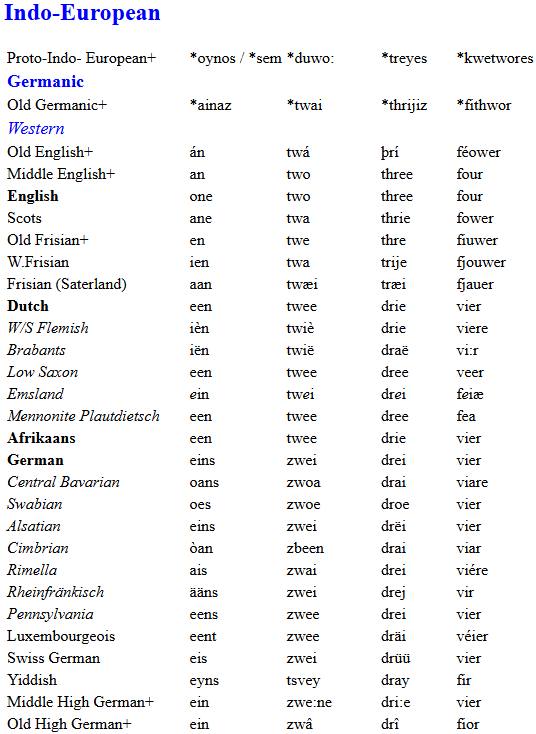
Looking at “four”, for example, we see that most of these western European languages start with “f” or “v”, and end in “r”; but the details vary a lot. Looking down a little further, we see languages in which the first sound is some kind of “k”:
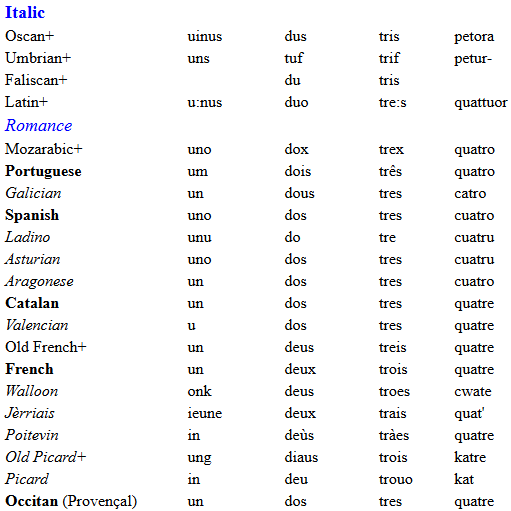
If you keep going, you’ll see even more variation.
So who made up the names we have in any one current language? Millions of people working together over centuries to turn existing languages into something new, starting with some unknown group of people who invented the first versions of those words … from who knows where?
One, two, three, … ten: From kwetwores to feower to four
Here’s a similar question from 2002:
Naming Small Numbers

Here's the question:

Why is "one" named "one," and why is "two" named "two," and why is "three" named "three"?
I answered again, referring to that existing answer, and trying to go deeper:
Hi, Aaron.

That's not an easy question to answer! You could ask the same thing about any word in our language: why is a dog called a dog? You could also ask your parents why you are called Aaron. In that case you can at least find out who chose the name, but even then you might not get a complete answer as to why. In general, words and names are what they are just because someone chose to use some word in the first place, and others have gradually changed it since then.

Here is a very unsatisfying answer in the Dr. Math archives that I gave to the same question once:

   Number Word Etymologies
   http://mathforum.org/library/drmath/view/52588.html

Here is another page I found about this (select: the topic English numbers, Etymology of):

   http://www.cenius.net/refer/az/default.php?Letter=e
I have changed the link to point to the copy preserved in the Wayback Machine. It focuses on the more recent history of the words:
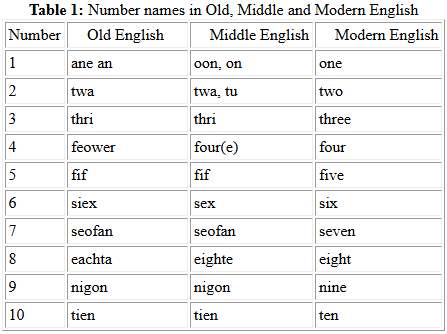
You may notice that these don’t all agree with the previous source. Can you guess why? (Hint: Spelling has not always been standardized as it is today! And people who spoke Middle English didn’t know that’s what it was.)
What these say is that you can look back in history to before there was an English language at all (and before anything was written down, so all we can really do is to guess at how words might have been said), and you will find the ancestors of the words we use for numbers today. You can see some family resemblances, even though the language was very different. For example, what we call "one" today was apparently pronounced in early English something like the name "Anna" (and is related to our word "a" or "an"), and came from a much earlier word that we might write as "oynos." All you can see in there from our "one" is the "n." Our "two" was pronounced "twa," with a real "w" sound, in early English, and something like "duo" in the great-great grandfather of English. Can you see how those are related?
It’s not uncommon that our spelling reflects a much earlier pronunciation. English is oddly both open to change and resistant to change!
So the answer is that we have no idea how the words we use for numbers were originally chosen, because they go back before there is any record of the language. Some of the words have hardly changed (like "three"); some have changed their pronunciation, but the spelling shows how they used to be said (like "two"); and others have changed a lot more (like "four," which in early English was "feower," but started out as "kwetwores."
Don’t forget, of course, that there are many languages that have no connection to Indo-European, and have even different words!
What about eleven and twelve?
Here’s a question from 1998 taking us a little further:
Counting in the Teens

I take Algebra 2, and one of the question we need to know the answer to is why, when you count, you go ten eleven twelve thirteen instead of ten eleventeen twelveteen thirteen.

I have looked everywhere for an answer. Could you please help? Thanks.
Or maybe it should be “ten, oneteen, twoteen, thirteen”? It’s clear enough that “teen” is related to “ten”, but what happened at the transition?
I answered yet again:
Hi, Alisha,

There's a fascinating discussion of this question (and some others like it) in the math-history-list:

  http://mathforum.org/kb/message.jspa?messageID=1375416

Look especially at the messages by John Conway; he discusses this also in his book _The Book of Numbers_.

Here's his answer on eleven and twelve:

  There seems to be a natural tendency in language for the first
  few terms of a sequence to be treated specially.  Thus in English,
  "eleven" is really "one left (over)",  and "twelve" is "two left",
  so that the implied "after ten" is omitted. But from thirteen on
  it seems that we should explicitly mention the "ten", since we're
  getting so far away from it that we might otherwise forget it!

So the "e" in eleven means "one", and the "tw" in twelve means "two"!
Math-history-list was a discussion forum hosted by The Math Forum, which also hosted Ask Dr. Math; I’ve changed the link, again, to the Wayback Machine’s copy, where you can still see the entire discussion. John Conway was a famous mathematician who was very active online.
We’ll be seeing more examples of his “first few terms” idea below; the first example will be … “first”!
More on the non-teens
In 2003 we had a similar question that was added to the same page:
What are your thoughts on the origins of the names for 11, 12 and 20?
I answered, looking for more sources, and showing what those early forms actually looked like:
Hi, Karen.

You can find more on this in a good dictionary, and in various books specifically dealing with the history of numbers.

In _Mathematics: From the Birth of Numbers_, Gullberg says this:

"Eleven is a derivative of Old English _endleofan_, where the terminal -fan is believed to carry the meaning of "to leave" or "left", that is, _one left_ after counting ten (fingers).

"Twelve has developed in a similar manner from Old English _twelfe_ meaning _two left over_ after counting ten; it may be more clearly seen from the Gothic _twailif_.

"Twenty was _twentig_ or _twegentig_ in Old and Middle English, where twen and twegen were forms meaning two, and the suffix -tig recalls German -zig."
Of course, there’s no good reason not to say oneteen, twoteen; but then, most words have no good reason. They’re just tradition.
Merriam-Webster, at m-w.com, has this to say on the etymology of the
words:

Eleven
Middle English enleven, from enleven, adjective, from Old English endleofan, from end- (alteration of An one) + -leofan; akin to Old English lEon to lend

Twelve
Middle English, from Old English twelf; akin to Old High German zwelif twelve, Old English twA two, -leofan (as in endleofan eleven)

Twenty
Middle English, from twenty, adjective, from Old English twEntig, noun, group of 20, from twEn- (akin to Old English twA two) + -tig group of 10; akin to Old English tIen ten
If you are familiar with other languages, you will recognize that each has its own quirks. For example, in French, 11 and 12 work the same way as other teens (11=onze, 12=douze, 13=treize, 14=quatorze, 15=quinze, 16=seize), but then 17 starts a new pattern that (almost) continues for later numbers (17=dix-sept, 18=dix-huit, 19=dix-neuf, 20=vingt, 21=vingt-et-un, …). But the “et” (and) is used only in the twenties. And it gets even weirder for 70, 80, and 90. Language has patterns, except where it doesn’t.
And you might have noticed something in the list of Latin numbers I showed last time: The early teens follow a simple pattern, but then 18 and 19 are related to 20 rather than to 10!
11=undecim, 12=duodecim, 13=tredecim, 14=quattuordecim, 15=quindecim, 16=sedecim, 17=septendecim, 18=duodeviginti, 19=undeviginti, 20=viginti
We don’t use that oddity in making English names for large numbers, because we want patterns.
What about forty?
Here’s a 1996 question, mostly about spelling:
Why Forty, not Fourty?

My 7th and eighth grade math classes from Rossville, Kansas have tried to figure out why the number "forty" is spelled as it is and not "fourty".  Dictionaries and encylopedias haven't been any help.

Would it have any relation to a Fort where there may have been 40 involved?
Doctor Sarah, our editor at the time, answered:
Hello there -

Trying to figure out why something is spelled the way it is in English is often frustrating.  :-)  Spelling didn't become very 'stable' until well after the time of Shakespeare; if your 7th and 8th graders haven't seen Shakespearean spelling yet, it might be an eye-opener for them.
We’ve seen this already, haven’t we?
A better question to ask of a good etymological dictionary like Webster's Second International might be where the words four and forty come from.  My dictionary says this:

ME. is Middle English, the language of England between about 1100 and 1500 A.D.

AS. is Anglo-Saxon, the language of the Saxon tribes that invaded England in the 5th and 6th centuries - from about 600 A.D.

OS. is Old Saxon, the language of the original Saxon tribes of northwest Germany between the Rhine and the Elbe rivers.

forty:  ME. forti, fourti, fowerti, from AS. feowertig; akin to OS. fiwartig, fiartig

four:   ME. four, fower, feower, from AS. feower; akin to OS. fiwar

So four and forty were different words starting a long time ago but were spelled with the same beginning in Old Saxon and Anglo-Saxon and part of Middle English.  Somewhere along the way during the Middle English era the simpler spelling of forty took hold and has continued ever since.
Why? Who knows! Maybe just to keep “fourty” from being too long; or maybe just because both were new spellings and no one cared for consistency.
Of course it was easier to change spellings before there were dictionaries and teachers paying close attention to your spelling. :-)

It's interesting to notice the British spellings of words like humour and labour, etc., which are spelled humor and labor in the United States.

I hope this helps answer your students' question.
But that doesn’t suggest that “forty” is an American spelling and “four” is British …
Ordinal numbers: First, second, third
A 2002 question takes us in a different direction:
Origins of Names of Ordinal and Cardinal Numbers

This may be more of a semantics or linguistics question than one of math, but I thought that you might find it interesting:  Which may have originated first...ordinal or cardinal numbers?

I have discussed (in my class on "Communications, Technology and Culture") the fact that in almost every language, the word for the number "one" is almost always entirely different than the corresponding ordinal number - e.g., "first" in English. "Two" and "second" are not much closer, but "three" and "third" start to have some similarities and by "four/fourth" the two concepts reach a similarity of pronunciation and, often, spelling (but the individual concepts are still understood to be different). But which might or should have come first?
I answered again:
Hello, Dr. Hesse.

I don't know that I'm an expert on this, but it's interesting to look at the etymology of these words. Here is an answer I gave to a related question:

Do you know where the ST, ND, RD and TH come from when we write and say ordinal numbers...1ST, 2ND, 3RD etc?  I have a first grade student who wants to know.  Thank You.
We can easily imagine that first, second, third, fourth are formed by putting those endings on variations of one, two, three, four; that makes sense at least in the last two. And we abbreviate them as if that were true. But it isn’t, is it?
Here’s my answer to that older question, which brings us close to the new question:
This isn't exactly a math question, but I like languages too!

Like many things in English (or other languages), such as verb tenses, we have "regular" and "irregular" number words. The simplest and oldest tend to follow their own odd patterns, and when you get into the newer and bigger words a pattern takes over. Clearly "-th" is the standard pattern for an ordinal number; so where do the other endings come from?

Actually, it's not just the endings but the whole words: "fir-" and "seco-" don't exactly come from "one" and "two", though you can see a connection between "third" and "three". Let's look at each word individually, using the American Heritage dictionary (which specializes in etymology) to see where they come from.

FIRST: This comes from Old English "fyrst". This is believed to come from a Germanic word "furista", which in modern English survives as "foremost". The "-st" is actually a superlative ending ("-est").

SECOND: This comes from Latin "secundus", meaning "following" or "next". It's a participle of the verb "sequor", which means "to follow" (as in  "sequel", "sequence", and "subsequent". So the ending "-nd" is a Latin gerund ending.

THIRD: This one finally comes from an English number: Old English "thridda" comes from "thri", three. I don't know enough Old English to know whether the "-d" is just a variant of the "-th" in other ordinals ("-t" in Old  English), but it appears that both are merely endings for ordinals.

So we see that "first" and "second" are different because they weren't originally ordinals at all, but special words for two special positions in a sequence, the "front-most" and the "next". "Third" almost falls into the normal pattern, and then things become regular (and were in Old English as well: feortha, fifta, ...).

Interesting, isn't it? Thanks for the question.
There’s a similar pattern in grammar: the most common little words, like “go” and “man” are irregular (“went”, “men”), but other words are regular, with a pattern taking over where memorizing individual forms would become too hard.
Back to Dr. Hesse’s question:
I would say that the words for cardinals and ordinals indicate not that one came before the other, but that they originated separately, with different purposes. And the difference (in English, at least) is not really a relic of the prehistoric development of Indo-European languages, but a relatively recent thing (after all, "second" is a borrowing from Latin). So I don't think we necessarily have any evidence of the sequence of events in ancient languages, but rather an evidence that small numbers were for a long time (and maybe still are?) perceived as something other than numbers in the full abstract sense. Consider also that in at least some languages "one" is hard to distinguish from the article "an", which does not carry a strong sense of number, just mere singularity.
As we’ve pointed out elsewhere, for a long time 0 and 1 were not thought of as numbers.