Recently in my college tutoring center, a student factored a quadratic polynomial using the X method, which I had heard of, but never watched being done for a hard example. Here on the site, a teacher recently asked about a related method I know as “slip-and-slide”. Both are “magical”, with no obvious reason they should work. Let’s look at these and some variations, ending with a non-magical version that combines the best of both worlds.
A surprising method, and a proof that it works
First, here’s the recent question about a variation on “slip-and-slide”:
Hi Dr Math,
I’m reading a procedure to solve quadratic equation.
Can you explain how to factorize 3x2 + 2x – 1 using the method where you multiply 3 by -1 to get x2 + 2x – 3, factor it into (x + 3)(x – 1), divide the constants by 3 to get (x + 1) (x – 1/3), and then clear the fraction to get the answer (x + 1)(3x – 1)?
Thank you in advance
This was Amia’s second try at this question that say; he had asked about this method earlier, but we had not yet answered; Doctor Rick answered this one while I was searching for past questions to refer him to in answering the first. In the first question, he’d shown his work for the problem:
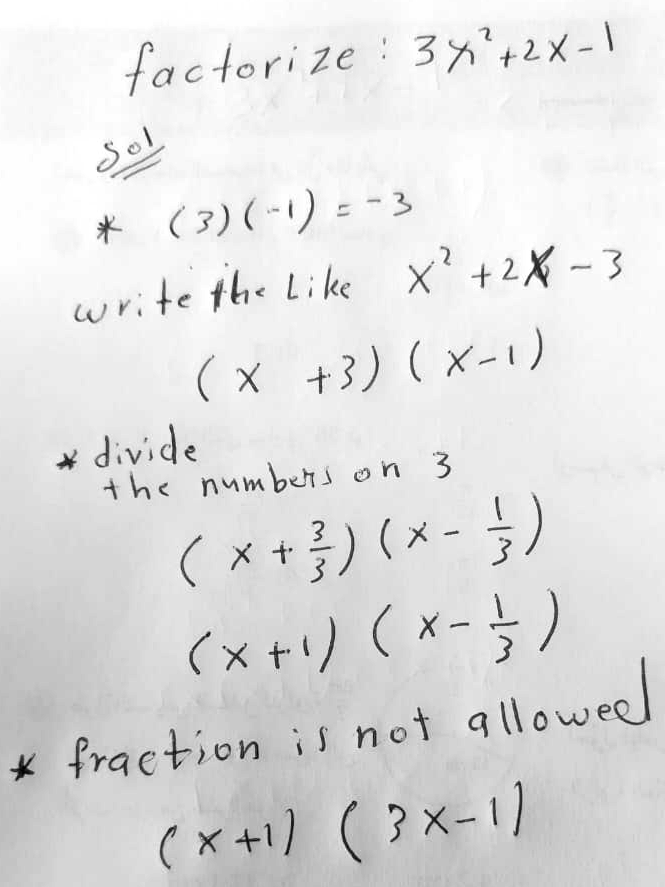
The method starts with a “magical” transformation to a non-equivalent quadratic that is easy to factor, followed by a “magical” transformation of the factors, and an elimination of fractions. We certainly need some reason to think it will work!
Amia added a little more:
I found a proof, but for the equation:
I need a proof for factorization, to understand why they convert the fraction so the form x – 1/3 becomes 3x – 1?
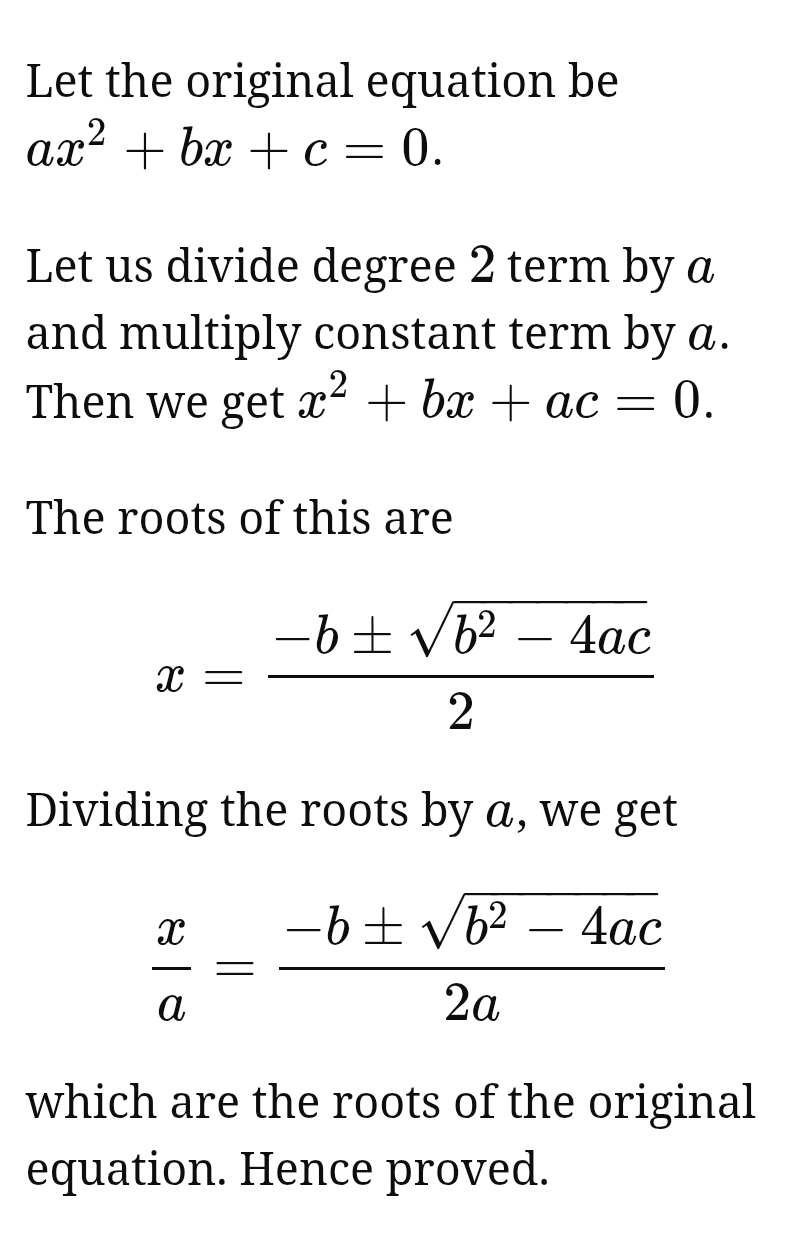
Take time to think about what the proof shows: The roots of the new equation (that is, the zeros of the new polynomial), when divided by the leading coefficient a, give the zeros of the original polynomial.
Doctor Rick first showed how to apply this proof to the polynomials themselves, and then focused on the final question, about why we change the factors at the end:
You have a proof that the zeros of the quadratic polynomial f1(x) = ax2 + bx + c are the zeros of f2(x) = x2 + bx + ac divided by a. Calling the zeros of the latter quadratic p and q, and introducing unknown multipliers k1 and k2, by the factor theorem we have
f2(x) = k2(x – p)(x – q)
f1(x) = k1(x – p/a)(x – q/a)
But the constant multiplier is just the leading coefficient of each polynomial, which is a for the original quadratic and 1 for the derived quadratic. Thus we find that
f1(x) = a(x – p/a)(x – q/a)
We can take the factor of a inside either factor, for instance
f1(x) = (ax – p)(x – q/a)
In your example, where p and q are –3 and 1,
3x2 + 2x – 1 = 3(x + 3/3)(x – 1/3)
= (x + 1)(3x – 1)
I chose to put the factor of 3 in the second linear factor to get rid of fractions. (It’s not that “fractions are not allowed”, but that we’d prefer not to have fractions if possible.)
We’ll see later that, more generally, we can split the constant a into the product of two factors and multiply each binomial factor by one of them, rather than having to multiply one by a itself. So we’ll be giving Amia a fuller answer to his question as we proceed.
But it’s worth mentioning that the reason for the last step (multiplying by 3) is not just to eliminate fractions, but to get the right leading coefficient. I always recommend checking a factorization by doing the multiplication; if we did this and found any term was wrong, we’d fix it.
We can show the (non-magical) connection between the two polynomials more directly: If we replace the variable \(x\) in \(ax^2+bx+c\) with \(\frac{x}{a}\), we get $$a\left(\frac{x}{a}\right)^2+b\left(\frac{x}{a}\right)+c=\frac{x^2}{a}+\left(\frac{bx}{a}\right)+c=\frac{x^2+bx+ac}{a},$$ so if \(x\) is a zero of the new quadratic, then \(\frac{x}{a}\) is a zero of the original. Therefore, as we’ve seen, if the new polynomial \(f_2(x)\) has factors \((x-p)(x-q)\), then the original polynomial \(f_1(x)\) has factors \(a(x-\frac{p}{a})(x-\frac{q}{a})\). We’ll be seeing this at the end!
The “slip-and-slide” method
Now, here is the first version of the question, from earlier that day:
Hi Dr Math,
I have a procedure or strategy to solve factorization of quadratic expression.
To factorize 3x2 + 2x – 1
Multiply 3 by – 1
Then write the equation in the form:
x2 + 2x – 3.
Then factorize it (x + 3)(x – 1).
The next step divides the constant by 3 to give
(x + 1)(x – 1/3)
Then every fraction changed to be (3x – 1).
The final answer is (x + 1)(3x – 1).
Can you explain it?
In the last step they don’t accept fraction; they convert x – 1/3 to 3x – 1.
Thank you in advance
I answered this one while Doctor Rick was writing:
Hi, Amia.
As I understand it, you don’t want an explanation of how to do that, but of why it works.
I see you have submitted another question that is essentially the same as this one, and it looks like Doctor Rick is answering it; I’ll give more or less the answer I envisioned writing this morning (before other needs took priority), and see if our answers are complementary.
(The “other needs” involved my 13-month-old twin granddaughters.)
First, the method you show here is what is sometimes called the “slip and slide” method, which my math department doesn’t want taught because it is “magical”, in the sense that it involves following rules without understanding why, and can’t be internally checked. I find it, for example, here (with a similar warning):
Math Bits Notebook: The Slide and Divide Method
My first exposure to it came in an early Ask Dr. Math question I answered, and my research led me to a better method based on a similar idea, the “ac-grouping method”.
The name “slip-and-slide” refers to “slipping” a from the first to the last term, making ac, and first “sliding” it under the constant terms, and then (after simplifying) “sliding” denominators back up to the x terms in the factors. The reference says,
This “short cut” method does not get the “Good Math Keeping” seal of approval. While this method yields correct results, the journey to get there will make no rational mathematical sense to students not versed in what is actually happening mathematically behind the scenes in this method.
Then she shows the hidden logic, as we will be doing.
(These methods are commonly taught in high schools, in some form, so I have told my own students they may use any method they know, but will not get partial credit if they use a method other than what I taught and get the wrong answer.)
Then I showed an old answer that we’ll look at below. But first, let’s look at a related method.
The X (or Diamond) method
Here is the method my recent student used, which I have found described as the [Big] X method, or the Diamond method; I’ll demonstrate it with a problem we’ll see again below:
To factor \(6x^2-x-12\), we first draw an X, putting the product \(ac=(6)(-12)=-72\) in the top, and the middle coefficient \(b=-1\) in the bottom:
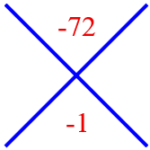
Next, we put \(a=6\) in the top part of each side:
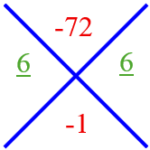
Then we find a pair of numbers whose product is \(-72\) and whose sum is \(-1\) (namely \(8\) and \(-9\)) under each 6:
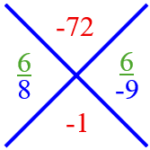
(Observe that \(8\) and \(-9\) are the numbers you would use in factoring \(x^2-x-72=(x+8)(x-9)\).)
Now we think of the left and right as fractions and simplify them (but leave the signs where they are):
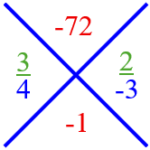
Finally, we read those fractions in the form \(\frac{p}{q}\rightarrow px+q\):
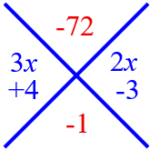
So the factors are \((3x+4)(2x-3)=6x^2-x-12\) as required.
The last steps are equivalent to writing factors \((x+\frac{8}{6})(x+\frac{-9}{6})\) and simplifying to \((x+\frac{4}{3})(x+\frac{-3}{2})\), then multiplying each factor by its own denominator to get \((3x+4)(2x-3)\). By flipping the fractions upside-down, they make it a little easier to read off the factors in order. This is essentially the same as Amia’s slip-and-slide, except that we never actually write fractions.
Magic, right? That’s the problem: There’s nothing here that makes any sense until the final check; there is no way to check that you put each number in the right place as you go along. Is that math? No; it’s taught as a shortcut for the math, to be used when the goal is just to get the answer, not to be thinking mathematically. That’s why I recommend against it, even though it’s valid. But at least this method doesn’t involve writing and factoring a different polynomial without explanation!
(Some presentations of the X method turn out to use the X just to set up for using the AC method, which we’ll look at next time (the same is true of the Diamond method), or only for the simple case where \(a=1\). That, I don’t object to at all. Others use it as part of an explicit slip-and-slide.)
Observe that it turns out that the coefficients of x, after simplifying (3 and 2 in the example) have a (here, 6) as their product, so that we get the correct leading term. It turns out that this is true as long as the quadratic has no common factor, which many presentations fail to mention. We’ll touch on this later. But try using any of these methods on, for example, \(6x^2+4x-2\). You’ll end up with \((x+1)(3x-1)\), which is the factorization of \(3x^2+2x-1\) instead.
How/why the slip-and-slide method works
Here is the 2002 question (from before I started teaching) that introduced me to the method:
Factoring Trinomials

My teacher gave me a method for factoring trinomials (ax^2 +bx +c). He didn't give me the name of the method but I know it's not FOIL or the grouping method (first part is similar).

Here's how to do it:

ex. 6x^2+19x-20
1) multiply the first coefficient by the constant
   (6)(-20)=-120
2) rewrite it to x^2+19x-120 (notice that 6 is no longer there)
3) factor the new trinomial (changes to x^2+bx+c)
   (x-5)(x+24)
4) add the first coefficient back to the equation (in front of x)
   (6x-5)(6x+24)
5) find the common factor of the numbers in each bracket
   ex. for the first bracket (6 and 5) there is
   no common factor so it's left as is;
   for the second bracket (6 and 24) the common factor is 6
   then divide each bracket by the common factor
6) result is (6x-5)(x+4)

Now, my question is, what's the logic/reason behind this method? How can I prove it? Now that I know the steps, I want to know why it works.

It may look complicated, but so far, this is by far the easiest way I have learned to factor trinomials. If you know an easier/faster way to do it, please feel free to comment.

Thank you.
You’ll notice a small difference from the slip-and-slide method in Amia’s form: Rather than write fractions at all, we put what would be the denominator before the x, and then remove any common factor This makes it essentially the same as the X method as we saw it.
I answered:
Hi, John.

I've never heard of this method, but it does work, and I like it, apart from the fact that it is magic, and I don't like to do magic without knowing why it works. Here's another example. We'll factor

    6x^2 - x - 12

We take the 6 from the first term and multiply the last by it:

    x^2 - x - 72

Factoring this, we see that 72 = 8*9 and 8 - 9 = -1, so

    x^2 - x - 72 = (x + 8)(x - 9)

Replacing x with 6x and pulling out common factors,

    (6x + 8)(6x - 9)

becomes

    (3x + 4)(2x - 3)

This is the desired factorization.
Note that I actually factored (positive) 72, looking for a difference of 1, then chose which factor needed the negative sign to get the right sum. By doing my own example, I made sure I understood how to use the method before analyzing it.
Now I'll prove that it works:

Suppose you are factoring

    ax^2 + bx + c

You factor

    x^2 + bx + ac = (x-m)(x-n)

(In my example, m = -8, n = 9.)

Now you replace x with ax:

    (ax-m)(ax-n) = (ax)^2 + b(ax) + ac
We’re following the method, and the next step will be to divide each of these factors, \(ax-m\) and \(ax-n\), by its GCF. But in working with unknown parameters, we don’t know anything about common factors of these numbers. What can we do? I saw something that appears to be true, but that I probably couldn’t prove convincingly without scaring John off! Luckily, John didn’t want a mathematically water-tight proof, just a reasonable explanation. So I just made an aside:
We'll have to assume that when you remove common factors, the product of the factors you divide out is equal to a. (In my example I took out 2 in the first factor and 3 in the second, whose product is 6.) I think this is a consequence of the assumption that a, b, and c have no common factors, but I'm not going to bother to prove it.
Although John hadn’t mentioned that the coefficients can’t have a common factor, I recognized that as a requirement for the method to work. My assumption didn’t have to be proved, because if it weren’t true for some problem, we’d just make a little adjustment in our result. Still, I had to mention it to continue my proof. We’ll see why this is true later.
Why is this needed? Instead of dividing by common factors, I can just divide the whole thing by a, which, I’m claiming, is the same as dividing each factor by its own GCF:
With this assumption, the resulting factorization is the same as

    (ax-m)(ax-n)/a = [a^2x^2 + abx + ac]/a = ax^2 + bx + c

So if you can follow your process, you have indeed factored the original trinomial.
We can also look at this the other way around, starting with the correct answer and seeing that the method will give the right factors:
Now let's take it in reverse. Suppose that you can factor your original trinomial:

    ax^2 + bx + c = a(x-p)(x-q)

so that we have

    b = -a(p+q)
    c = apq

(In my example, p=-4/3, q=3/2. I am only expecting them to be rational, not integers. When we multiply by a, we know that apq is an integer so the product of the denominators of the roots, in reduced form, must divide a.)
Any factorization can be written in this form, as a constant times the product of monic polynomials (with leading coefficients 1). In particular, if it can be factored as \(ax^2+bx+c=(mx+n)(rx+s)\) where m, n, r, and s are integers, then we can rewrite that as \(mr(x+\frac{n}{m})(x+\frac{s}{r})\), where \(-\frac{n}{m}=p\) and \(-\frac{s}{r}=q\) are the roots, which will be rational.
Note also that clearly \(mr=a\), and if either m and n, or r and s, had a common factor, then we could have factored out a numerical factor from the entire polynomial, and our assumption that a, b, and c had no common factor would be violated. This justifies my earlier assumption.
Now we want to obtain the factors of the modified equation:
Then we find that

    x^2 + bx + ac = a[x^2/a + b/a x + c]
                  = a[a(x/a)^2 + b(x/a) + c]
                  = a[ay^2 + by + c]         where y=x/a
                  = a^2(y-p)(y-q)
                  = a^2(x/a-p)(x/a-q)
                  = (x-ap)(x-aq)

Note that our m and n from above are ap and aq, which will be integers.

Therefore, if you can factor the given trinomial (using integers), you can also factor x^2 + bx + ac, and will be able to follow your procedure. So it looks as if your method is a valid method that will apply to any factorable trinomial.
In searching for information about the method at the time, I found only one (poor) source, but several explanations of the related AC method, the only one that still exists being our own:
Looking in our archives to see if we are aware of this method already, I found that the method given here is somewhat equivalent, in that it has you factor ac into factors whose sum is b, which is just what you do to factor x^2 + bx + ac:

   Two Methods of Factoring Quadratics
   http://mathforum.org/library/drmath/view/52878.html
The link describes what is commonly called the “AC method” (which I call “ac-grouping” to distinguish it from other methods that also involve ac) and completing the square. I immediately preferred the AC method, “because it is easier to explain why it works”.
Explaining it with an example rather than variables
John replied:
Thanks for the quick reply!

Is there an easier way you can prove this method? I don't quite get your explanation (too many variables and very complicated).

Thank you.
The algebra in my proof does require careful reading. I responded:
Hi, John.

Sorry, this is how things are proved in algebra. The parameters a, b, and c allow us to talk about any possible quadratic trinomial, and the roots m and n allow us to talk more easily about factoring it without having to write them in terms of the quadratic formula, which would be even more confusing. So all the variables are there for good reasons. But if you read through what I wrote one step at a time and don't let it overwhelm you, you should (at least when your algebraic understanding is more mature) be able to follow it without much trouble.
So a complete proof will require some such work.
But until you can do that, it may help if we look at an example to see what is happening, avoiding all the parameters. Let's take my example, where we factor

    6x^2 - x - 12

The modified trinomial is

    x^2 - x - 72 = (x + 8)(x - 9)

Replacing x with 6x, this is

    (6x)^2 - (6x) - 72 = (6x + 8)(6x - 9)
                       = 2(3x + 4) * 3(2x - 3)
                       = 6(3x + 4)(2x - 3)

But we can rearrange the left side to look like this:

    6*6x^2 - 6*x - 6*12 = 6(6x^2 - x - 12)

Do you see what this shows?
It shows that \(6(6x^2-x-12)=6(3x+4)(2x-3)\), so that \(6x^2-x-12=(3x+4)(2x-3)\), and we’ve factored the original polynomial.
Again, I can reverse the process, to show why the original can be factored by this method:
I'll put it all in a different order to make it clearer. If we take our original trinomial and multiply it by 6 (the coefficient a), we get

    6(6x^2 - x - 12)

Then we can distribute the 6:

    6^2 x^2 - 6x - 72

Now express this in terms of 6x:

    (6x)^2 - (6x) - 72

To make it easier, let's introduce a new variable y = 6x:

    y^2 - y - 72

Now we can factor this:

    (y + 8)(y - 9)

Having done that, we can replace y with 6x again:

    (6x + 8)(6x - 9)

Now we can factor out a 2 from the first factor and a 3 from the second:

    6(3x + 4)(2x - 3)

But this is equivalent to what we started with:

    6(6x^2 - x - 12) = 6(3x + 4)(2x - 3)

Divide both sides by 6, and we've factored our trinomial:

    6x^2 - x - 12 = (3x + 4)(2x - 3)

That's what you are really doing, with the magic removed.
Two days later, I had an opportunity to use my newly-learned AC method:
Finding a Single Pair of Factors
We’ll look at that next time.
A non-magical version of slip-and-slide
In 2009 we got a helpful comment, which was tacked onto this page (and also the AC method page):
Dear Dr. Math,

In refereeing for a journal article, I came up with the following:

  If y = ax then ax^2 + bx + c = (1/a)(y^2 + by + ac)
  which gives a quick and easy method of factoring ax^2 + bx + c.

I thought it was new until I Googled it and found your post.

My explanation above may be shorter and easier for students to understand.  Also, for an experienced user, the method can be presented in a very quick and direct form:

  ax^2 + bx + c = (1/a)(ax + ?)(ax + ?)
  where the two ?'s should multiply into ac and sum into b.

Best regards,

Li
This suggestion brings the essentials of the proof of the slip-and-slide method out into the open, so that it makes sense.
I responded:
Hi, Li.

I've never until now heard an explanation of this method that actually justifies it and doesn't just tell the student to magically replace one trinomial with another; both of your approaches here make a lot of sense, and may change it from a method I avoid into one I may end up teaching as my preferred method.  (My math department officially forbids teaching the "slip and slide" method, as they call it, because it does not involve transforming the expression into a series of equivalent expressions, and so is mathematically unjustified.)  I currently teach the "ac" method, which I learned for the first time in the course of answering this question; that method is taught in the texts I've used since then, along with trial and error.
Will it make good sense to students who are not yet comfortable with algebra (like our John above)? I expanded both of Li’s approaches.
Let me fill in the details in what you wrote, to see how I would explain it to students.  I generally start by showing an example, and then generalize; so I'll work with the trinomial 6x^2 - x - 12.

First, for students able to handle a change of variables: We choose (for no obvious reason, except that it turns out to work) to rewrite the equation in terms of a new variable u = 6x.  This means we are replacing x with u/6:

  6x^2 - x - 12 = 6(u/6)^2 - (u/6) - 12
                = 1/6 u^2 - 1/6 u - 12

Now we factor out 1/6, which means we see 12 as 72/6:

                  u^2 - u - 72
                = ------------
                        6

Now we just have to factor a trinomial of the easy kind; we get

                  (u - 9)(u + 8)
                = --------------
                         6

We have to put the answer in terms of x, so we replace u with 6x:

                  (6x - 9)(6x + 8)
                = ----------------
                         6

Now we factor out the common factor from each factor here, and cancel those with the 6:

                  3(2x - 3) 2(3x + 4)
                = -------------------
                           6

                = (2x - 3)(3x + 4)

This, as you say, is the same method as on the page you refer to, except that every step is justified and we aren't just jumping from one trinomial to one that is not equal to it.
This sort of change of variables is taught in our College Algebra course; beginning algebra students first learning to factor would likely not be ready for it.
Your second approach doesn't require the second variable, which beginning students would have trouble with; here's how I'd explain it:

We try putting 6x in each of the prospective factors, just as we put x in each factor in the easy case; but we realize we have to divide that by 6 to make it come out right, so we write

                  (6x + _)(6x + _)
  6x^2 - x - 12 = ----------------
                         6

What's written so far makes sense, since we have 36x^2 / 6 = 6x^2. Now, just as in the simple case, we look at how we can fill in the blanks.  Call them p and q for now.  The last term of the trinomial will be pq/6, so pq has to equal 6*-12 = -72.  The middle term will be

  (6x*q + p*6x) / 6 = (p + q)x

so p + q has to equal -1.  As usual we find that p and q are -9 and 8, so we have

                  (6x - 9)(6x + 8)
  6x^2 - x - 12 = ----------------
                         6

and from here we do the same as in the other method, factoring out the common factor.
So we can do just what is done in slip-and-slide (find that pair of numbers and put them directly into the factors), but there is a reason for everything we do, even if we treat it as a shortcut, skipping the details. So the proof is baked into the initial example.
The nice thing here is that, like the ac method I usually teach, it centers around the same process as in the first case (finding a pair of numbers whose sum and product are known), but it doesn't require the process of factoring by grouping, and it's easy to see why it works (though not, perhaps, how you would think of it!).  So I'm going to try this last approach with my next class and see if they like it.

Thanks for your contribution!  If you have any more thoughts (and especially if I've missed a good way to explain it) please let me know.
I don’t think I ever did teach this method, unfortunately, so I have no evidence of its efficacy. I’ve found that teaching the AC-Grouping method helps reinforce both of the methods it’s built on, and requires less new learning. But that does make it a little more time-consuming.