Last time we looked at names of anniversaries (like “semiquincentennial” for the 250th), and other words based on Latin numbers (like “septuplets” for 7 babies). Let’s back up and look at the names in English for large numbers themselves, like million, trillion, and vigintillion. We’ll work up to the big ones!
Millions and beyond
First, here’s a general question and answer from 1996:
Names of Large Numbers

My Gifted elementary school students are trying to find very large numbers. The highest that they have found so far is a "vigintillion" (1 + 63 zeroes). They couldn't find other numbers between a vigintillion and a centillion.  Can you help?
The list they presumably found would look like this:
- million
- billion
- trillion
- quadrillion
- quintillion
- sextillion
- septillion
- octillion
- nonillion
- decillion
- undecillion
- dodecillion,
- tredecillion
- quattuordecillion
- quindecillion
- sexdecillion
- septendecillion
- octodecillion
- novemdecillion
- vigintillion
You may recognize the Latin prefixes from last time, for numbers from 2 to 20.
Doctor Tom answered realistically:
You mean names for numbers, right?

I've never heard of any others myself.  Names for such large numbers are basically useless, so it's not surprising that there are only a limited number of them.  The vast majority of people don't even know what a vigintillion is, so it's sort of useless to use the word.  It's much easier to use scientific notation, because then the size of the number is obvious: 1*10^63.
But there’s more: Even the numbers listed don’t have definite meanings!
Besides, in the English speaking world, at least, there's already disagreement about what the word "billion" means.  In the United States, it means 10^9; in Great Britain, it means 10^12.  The Brits add 6 zeroes per step up, and we add 3.  So a British "trillion" is 10^18.

In a sense, the British system makes more sense -- "bi"llion, "tri"llion, "quad"rillion, et cetera indicates 2, 3, and 4 from the roots of the names.  If you think of them as meaning 2, 3, and 4 groups of 6 zeroes, everything makes good sense -- and it makes no sense in the US system.
We could describe this by saying that “n-illion”, using the Latin prefix for the number n, means \(1,000,000^n=10^{6n}\) in the British system (also called the “long scale”), but \(1000\times1000^n=10^{3n+3}\) in the American system (“short scale”). So vigintillion (\(n=20\)) can be either \(10^{6\cdot20}=10^{120}\) or \(10^{3\cdot20+3}=10^{63}\) as stated in the question. (As we’ll see, “British” is a misnomer now.)
So what is a billion, really?
That question about billions came into focus here, in 2001:
American vs. European Billion

I don't know if this is really a math question but I asked myself this question during my whole school time. Even my teachers can't answer this question.

The American system is:
10^06 = million
10^09 = billion
10^12 = trillion
...

The European system (formerly used in Britain, still used in Germany) is:
10^06 = million
10^09 = thousand million
10^12 = billion
10^15 = thousand billion
10^18 = trillion
10^21 = thousand trillion
...

Why the differences? I hope you can help me.

Walter
He got answers from both sides of the pond! First, Doctor Anthony (British):
The reason for the difference is historical and relates to the fact that Latin is not taught to the same extent in America as in Europe.  The bi-million, tri-million is an obvious extension from 10^6 to 10^12 to 10^18 in the European system and these become billion and trillion, respectively.

In America the need for a simple word for 1000 million and an absence of Latin led to the misappropriation of the word 'billion'.  England held out for a long time with the 10^12 meaning of billion, but was eventually overwhelmed by the sheer weight of scientific and mathematical literature that used the American interpretation, so billion in England is now used in the American sense. Europe may eventually follow suit, but it will be a change from a logical system to an arbitrary one.
There’s a lot of truth there. In most European languages other than English, equivalents of the old “British” forms (“billion” meaning \(10^{12}\)) are used, but the usage changed in the U.K., first gradually, and then officially in 1974, so that “billion” now means \(10^{9}\) as in the U.S.. Those who use the “long scale” often fill in the missing \(10^9\) with the word “milliard”.
For example, the translations for U.S. “billion” (\(10^{9}\)) and “trillion”” (\(10^{12}\)) in various languages are:
- English (American and current British): billion, trillion
- Spanish: mil millones [thousand million], billón
- French: milliard, billion
- German: Milliarde, Billion
- Italian: miliardo, bilione
- Greek: δισεκατομμύριο (disekatommýrio) [second hundred-mytiad = bi-million], τρισεκατομμύριο (trisekatommyrio) [third hundred-myriad = tri-million]
- Russian: миллиард (milliard), триллион (trillion)
- Hebrew: מיליארד (miliard), טרִילִיוֹן (terilion)
- Arabic: مليار (milyar), تِرِلْيُوْن (tirilyūn)
- Chinese: 十億 (Shí yì = ten myriad-squared), 兆 (zhào = myriad-cubed)
Russian, Hebrew, and Arabic appear to be transliterated from the short scale, but use milliard for billion to avoid confusion.
Interestingly, several languages (Greek, Chinese) have systems based in some way on myriads (10,000); Greek fits this into a short-scale system. Chinese, Japanese, and Korean are like the long scale but based on myriads rather than millions, (as if “myriad”, “byriad”, “tryriad” meant \(10^4\), \(10^8\), \(10^{12}\)!), with a unique word for each power of 10,000. I won’t try to dig deeper into this; the point is that non-European languages have their own issues.
Wikipedia has nice coverage of all this, including a map: 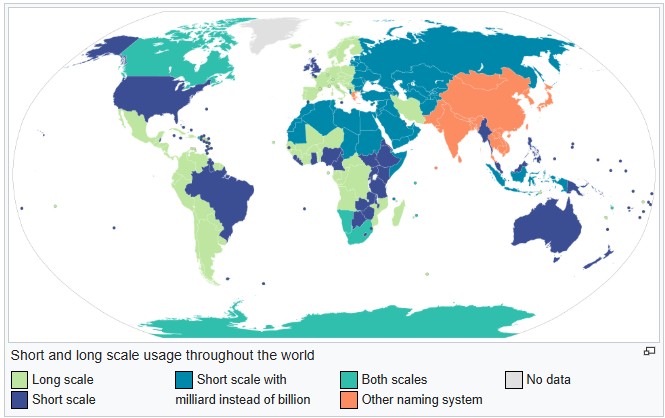
I couldn’t, however, let the implied put-down of America pass, so I added an answer, correcting the history:
It sounds plausible, especially from a British perspective, that the "arbitrary" American system should be due to our lack of education; but I'm not sure the charge holds up to historical investigation. I'm suspicious, in the first place, because I know from my own ancestors' heritage that Latin was an important part of American education at least in the 19th century, and surely also before then for those who were educated. It may be true that Latin is not taught enough here, but that has not always been true.
We have my great-grandfather’s Latin books, for example, and such “classical education” was a mark of the educated long before him. So, did educated Americans invent a wrong meaning for words that, regardless, come from Latin roots, because they didn’t know better? I looked up the history of “million” and other words in one of our standard sites at the time:
As our friend Jeff Miller says [under Million], first quoting D. E. Smith,

  http://jeff560.tripod.com/m.html

"The French use of milliard, for 10^9, with billion as an alternative, is relatively late. The word appears at least as early as the beginning of the 16th century as the equivalent both of 10^9 and of 10^12, the latter being the billion of England today. By the 17th century, however, it was used in Holland to mean 10^9, and no doubt it was about this time that, the usage began to change in France."

[This isn't quite clear, but "billion" meant 10^9 in France at least by the early 18th century.]
The quote is from Smith’s History of Mathematics. He is saying, as I understand it, that the French used both “billion” and “milliard” for \(10^9\), and “milliard” for both of the numbers that are called “billion”!
Here is the original, showing the whole context: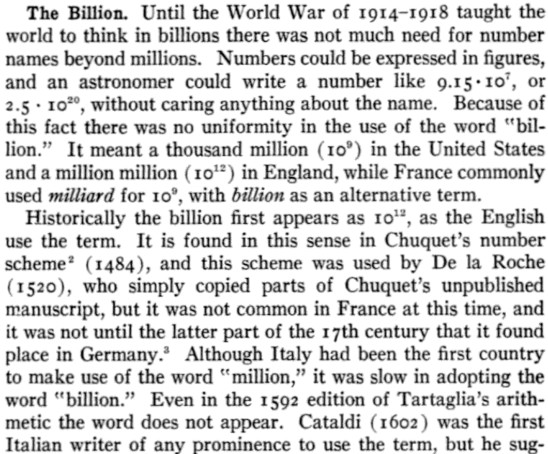
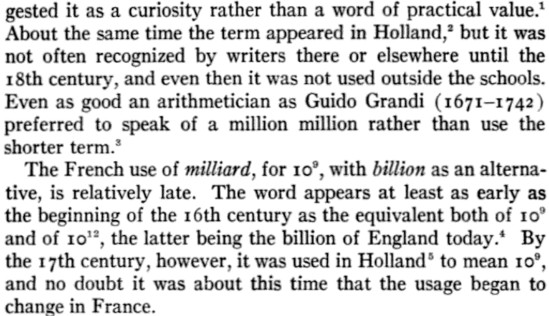
So what we think of as the old British meaning for “billion” (the long scale) did come first; but footnote 1 says that the Italian Cataldi used “millioni”, “billioni” or “duillioni”, ” trillioni” for \(10^6,10^9,10^{12}\), following the short scale. And “milliard” was used for both \(10^9\) and \(10^{12}\). Things were confused from the start! Continuing in Smith,
"As to the American usage, taking a billion to mean a thousand million and running the subsequent names by thousands, it should be said that this is due in part to French influence after the Revolutionary War, although our earliest native American arithmetic, the Greenwood book of 1729, gave the billion as 10^9, the trillion as 10^12, and so on. Names for large numbers were the fashion in early days, Pike's well-known arithmetic (1788), for example, proceeding to duodecillions before taking up addition."
Here is the original:

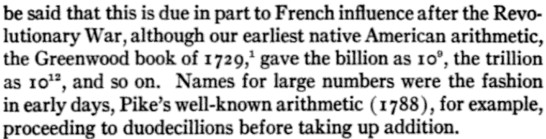
I love this idea that the words we are discussing were a fad, much as some children find them fascinating, though they are ultimately of little use. But it’s not the values assigned that were sort of childish, but the very idea of naming such numbers!
Miller continues, now quoting the Oxford English Dictionary:
Further, from the OED,

"The name [billion] appears not to have been adopted in Eng. before the end of the 17th c. .... Subsequently the application of the word was changed by French arithmeticians, figures being divided in numeration into groups of threes, instead of sixes, so that F. billion, trillion, denoted not the second and third powers of a million, but a thousand millions and a thousand thousand millions. In the 19th century, the U.S. adopted the French convention, but Britain retained the original and etymological use (to which France reverted in 1948).  Since 1951 the U.S. value, a thousand millions, has been increasingly used in Britain, especially in technical writing and, more recently, in journalism; but the older sense "a million millions" is still common."
I commented on this:
Putting this together, we see that the "American" use of "billion" originated not here but in France; and that it was probably based not on stupidity, but on practicality (another well-known characteristic of Americans), as there was more need for a name for 10^9 than for 10^12. There _is_ logic behind the usage; in this system, billion doesn't mean "million squared" but "second -illion" counting by thousands. It's hardly different from deciding whether to index arrays starting at 0 or 1. You just have to choose where to start and how big a step to take, and the numbers follow a logical progression.
The long scale has a slightly nicer logic, and appears to be older, but usefulness counts for a lot, too. It appears that some authors in France and Italy in the 1600’s switched to the short scale when it became common to write commas between periods of 3 digits rather than 6, which would feel logical. This was brought to America in the 1700’s, and then became official in France in the 1800’s; France changed back to long scale by 1961, and Britain changed to short scale in 1974.
I fully agree that the original British usage is nicer and easier to explain, and I wish it were the standard system; but the other is not really arbitrary. It should also be noted that France, not Britain, was the center of mathematical scholarship at the time "billion" was imported into America, so it can be reasonably suggested that the Americans adopted it for the same reason the British have more recently: it was used by the most important writers.
Ultimately, like other issues (PEMDAS comes to mind), we just have to be aware that different cultures make different choices, and live with the ambiguity. Scientists just avoid using number names, instead using scientific notation and metric unit prefixes.
Now we can fill in meanings in our list through vigintillion:
- Short Long Name
- \(10^{6}\) \(10^{6}\) million
- \(10^{9}\) \(10^{12}\) billion
- \(10^{12}\) \(10^{18}\) trillion
- \(10^{15}\) \(10^{24}\) quadrillion
- \(10^{18}\) \(10^{30}\) quintillion
- \(10^{21}\) \(10^{36}\) sextillion
- \(10^{24}\) \(10^{42}\) septillion
- \(10^{27}\) \(10^{48}\) octillion
- \(10^{30}\) \(10^{54}\) nonillion
- \(10^{33}\) \(10^{60}\) decillion
- \(10^{36}\) \(10^{66}\) undecillion
- \(10^{39}\) \(10^{72}\) dodecillion,
- \(10^{42}\) \(10^{78}\) tredecillion
- \(10^{45}\) \(10^{84}\) quattuordecillion
- \(10^{48}\) \(10^{90}\) quindecillion
- \(10^{51}\) \(10^{96}\) sexdecillion
- \(10^{54}\) \(10^{102}\) septendecillion
- \(10^{57}\) \(10^{108}\) octodecillion
- \(10^{60}\) \(10^{114}\) novemdecillion
- \(10^{63}\) \(10^{120}\) vigintillion
Here is a similar list from the 1859 (American) book The Normal: or Methods of Teaching the Common Branches, Orthoepy, Orthography, Grammar, Geography, Arithmetic and Elocution by Alfred Holbrook:
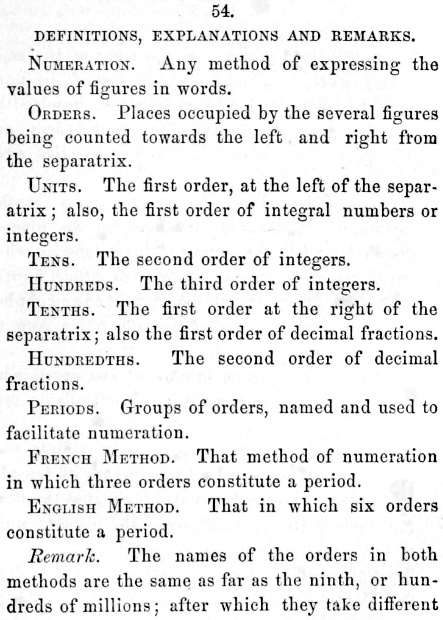
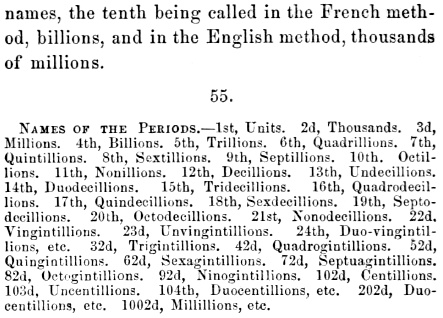
This confirms that at the time this short scale was considered the French system; the spellings differ a little from ours, some being typos. (But note two meanings given for “duocentillion”! We’ll see that again.)
That takes us beyond vigintillion. Let’s go there next.
Extending the list
This question from 1998 takes us there:
Decillion, Vigintillion, Trigintillion...

After seeing your posting on Large numbers

[see http://mathforum.org/dr.math/faq/faq.large.numbers.html   ]

I see the pattern.

Could you please complete the following pattern?

   1 with 33  zeros after it is a Decillion
   1 with 63  zeros after it is a Vigintillion
   1 with 93  zeros after it is a Trigintillion
   1 with 123 zeros after it is a ?
   1 with 153 zeros after it is a ?
   1 with 183 zeros after it is a ?
   1 with 213 zeros after it is a ?
   1 with 243 zeros after it is a ?
   1 with 273 zeros after it is a ?
   1 with 303 zeros after it is a Centillion

I'm writing a program that will convert numbers into the text of how to say them.

Example:

   input: 120340000000
   output: OneHundredTwentyBillionThreeHundredFortyMillion
Clearly Brennan is assuming the short scale, in which n-illion refers to \(10^{3n+3}\). And his output ought to have spaces and commas, so that 120,340,000,000 is “one hundred twenty billion, three hundred forty million”. Every “period” of three digits gets a name. What are they?
Doctor Schwa answered with a terse reference to a then-recent book that offered a clearly defined proposal:
From John Conway and Richard Guy, _The Book Of Numbers_, p. 15:

[The * below means:
When it is immediately before a component marked with s or x, tre increases to tres and se to ses or sex as appropriate. Similarly septe and nove increase to septem and novem or septen and noven immediately before components marked with m or n.]

  units: (prefixes)

     un
     duo
     tre (*)
     quattuor
     quinqua
     se (*)
     septe (*)
     octo
     nove (*)

  tens:

     (n)  deci
     (ms) viginti
     (ns) triginta
     (ns) quadraginta
     (ns) quinquaginta
     (n)  sexaginta
     (n)  septuaginta
     (mx) octoginta
          nonaginta

  hundreds:

     (nx) centi
     (n)  ducenti
     (ns) trecenti
     (ns) quadringenti
     (ns) quingenti
     (n)  sescenti
     (n)  septingenti
     (mx) octingenti
          nongenti
The roots come straight from Latin numbers:
1  unus
2  duo             20   viginti
3  tres            30   triginta
4  quattuor        40   quadraginta
5  quinque         50   quinquaginta
6  sex             60   sexaginta
7  septem          70   septuaginta
8  octo            80   octoginta
9  novem           90   nonaginta
10 decem           100  centum
11 undecim         200  ducenti
12 duodecim        300  trecenti
13 tredecim        400  quadrigenti
14 quattuordecim   500  quingenti
15 quindecim       600  sescenti
16 sedecim         700  septingenti
17 septendecim     800  octingenti
18 duodeviginti    900  nongenti
19 undeviginti    1000  mille
It is common today to use “quin-” (as in “quindecim” and “quingenti”) instead of “quinque” for 5, and dictionaries do not always agree with this system, but it’s nice to have some system. Note that Latin used “2 less than 20” for 18 and “1 less than 20” for 19, but we don’t follow that in our prefixes.
We’ll explore the system in more detail below, so don’t worry if you have trouble following it. But for an example, if \(n=999\), we find that \(10^{3(999)+3}=10^{3000}\) is nove-nonaginta-nongentillion, and if \(n=357\), we find that \(10^{3(357)+3}=10^{1074}\) is tres-quinquaginta-septingentillion.
Conway and Guy also describe a method to extend this to the naming of all numbers,

  by combining these according to the convention that XilliYilliZillion
  (say) denotes the (1000000X + 1000Y + Z)th zillion, using "nillion"
  for the zeroth "zillion" when this is needed as a placeholder. So
  for example the million-and-third zillion is a "millinillitrillion".

That means (American) 10^3000012, or (British) 10^6000018.

I hope you enjoy this idea as much as I do! Anything that gives me an excuse to use the word "zillion" and "millinillitrillion" makes my day.
The example has \(x=1, y=0, z=3\), making \(n=1,000,003\), giving \(10^{3(1,000,003)+3}=10^{3,000,012}\).
I won’t dig into this invented system, but it, too, is discussed briefly in Wikipedia.
Conway and Guy explained
A 2002 question elicited a deeper explanation of that:
Numbers Larger Than Centillion

Are numbers like bicentillion, tricentillion, or quadracentillion true or made up? I found the infamous milletillion. With the prefix mille follow the prefixes: micre-, nane-, pike-, femte-, atte-, zepte-, yocte-, followed by -tillion. Could you tell me what you know about numbers beyond centillion?
This is a mixture of different numbering systems!
I answered, first saying again that we are largely playing games here:
Hi, Lawrence.

I assume you found our FAQ on the topic,

   Large Numbers and Infinity
   http://mathforum.org/dr.math/faq/faq.large.numbers.html

and looked at the various links there that go deeper. You will have found that these number names, beyond vigintillion or so, if not even beyond decillion, are by no means "official," and anyone can really make up his own version without much of a challenge. That's because these names are nothing but a curiosity, and are not really used for anything. People make them up just because they like orderliness, and want to see the pattern continued as far as they can. Some just invent their own names, because they recognize that the commonly accepted names are not really as orderly as they like; that is true for example here:

   Large Numbers - Russ Rowlett
   http://www.unc.edu/~rowlett/units/large.html

where, to my knowledge, the "Greek-based names" are his own invention.
So these are mostly something to have fun with — but there are real patterns to follow, as we’ve seen.
Rowlett’s system is discussed by the Math Doctors in
Naming Large Numbers
I referred to the answer we just looked at:
In Decillion, Vigintillion, Trigintillion...
   http://mathforum.org/dr.math/problems/trichardt12.10.98.html

we have a summary of a naming scheme proposed by Conway and Guy to extend the names far beyond those that are normally used. In this scheme, you would use names like "ducentillion" and "trecentillion" for "200 and 300 sets of zeroes," to distinguish them from "duocentillion" for "102". I haven't seen bicentillion in any believable source.
My phrase “sets of zeros” is intentionally vague, as it depends on which number system you are using! But note the subtlety I point out: “du”, “duo”, and “bi” seem like they ought to mean the same thing, but a distinction is needed. That’s exactly why a systematic approach was necessary.
You apparently have found other versions that I haven't seen. All of these are "made up," though all of them are attempts to follow an orderly scheme, usually to extend the familiar names to larger and larger bounds. Some are more nonsensical; the page that suggests the "micretillion" seems to come from someone who forgot that "micro-" as a metric prefix means "millionth," not "million"! (Lots of other things on that page are wrong; for example, it is not "hendecillion" but "undecillion," since "hen-" is a Greek prefix that doesn't belong with Latin roots; he spells "vigintillion" and "trigintillion" wrong as well.) That untrustworthy page is

   Numeric Terms Glossary - D.T.
   http://members.cts.com/hollywood/d/davidtan/site25/25nterms.htm
I can’t find that page even in the Internet Archive; it seems that it rightly went to oblivion! I find no use of “micretillion” anywhere, but “micrillion” seems to have been invented by others with the same faulty reasoning. Similarly, Lawrence’s “infamous milletillion” is only mentioned as an alternative to “millillion”, which is valid in Conway and Guy. So the Internet appears, for a change, to have largely corrected itself here.
So what is “true”?
I would go with Conway and Guy, if only because they are respected mathematicians with knowledge of linguistics as well. This page gives their system again, with more detailed rules and examples:

   Large Numbers - Robert Munafo
   http://mrob.com/pub/math/largenum.html

The rules for extending up to 10^3000 are given in _The Book of Numbers_ by Conway and Guy. The name is built out of pieces representing powers of 10^3, 10^30 and 10^300, as shown by this table:

x  10^3 x          10^30 x            10^300 x      10^3000 x
0  -  -  -
1  un         (n)  deci         (nx)  centi         mille
2  duo       (ms)  viginti      (n)   ducenti
3  tre (s)   (ns)  triginta     (ns)  trecenti
4  quattuor  (ns)  quadraginta  (ns)  quadringenti
5  quinqua   (ns)  quinquaginta (ns)  quingenti
6  se (sx)    (n)  sexaginta    (n)   sescenti
7  septe (mn) (n)  septuaginta  (n)   septingenti
8  octo      (mx)  octoginta    (mx)  octingenti
9  nove      (mn)  nonaginta          nongenti

The rules are:

   - Take the power of 10 you're naming and subtract 3.

   - Divide by 3. If the remainder is 0, 1 or 2, put one, ten or one
     hundred at the beginning of your name (respectively).

   - Break the quotient up into 1's, 10's and 100's. Find the
     appropriate name segments for each piece in the table.

   - String the segments together, inserting an extra letter if the
     letters shown in parentheses at the end of one segment match a
     letter in parentheses at the beginning of the next. For example:
     septe(mn) + (ms)viginti = septemviginti.

   - If the result ends in a, change the a to i.

   - Add llion at the end. You're done.

Many of the resulting names are only slightly different. For example 10^261 is sexoctogintillion and 10^2421 is sexoctingentillion. Then there's 10^309 = duocentillion and 10^603 = ducentillion.
This, of course, is part of the reason all these huge numbers are meaningful only in play. If you want to be clear, you just write the digits.
Pingback: Names of Small Numbers: One to Twenty – The Math Doctors