Hyperbolic functions are functions that form a sort of parallel universe to the trigonometric functions. They are typically introduced as an aside while teaching calculus – because they happen to be useful there, and also because they can’t really be understood without calculus. As a result, we can easily misunderstand them, forget about them, and fail to benefit from them. Here we’ll see derivations of their basic formulas, with a side discussion of what it means to define a new function.
Defining sinh and cosh as analogues of sin and cos
We’ll start with this question from 1998:
Hyperbolic Functions

Hi,

I was wondering:

 ex: sin(angle) = side of triangle
     arcsin(side of triangle) = angle

but if the function is sinh or cosh, what does the inverse function give you? What does the inverse of sinh or cosh mean?

 ex: arcsin(side or number) = angle
     inverse sinh(some number)=?
The sine function \(\sin(x)\) takes an angle x and gives us a ratio of sides in a right triangle with that angle; the arcsine function is its inverse, taking the ratio and giving us back the angle x.
Presumably Yoshi was taught that the hyperbolic sine (sinh) and cosine (cosh) are defined by $$\sinh(x)=\frac{e^x-e^{-x}}{2}\\\cosh(x)=\frac{e^x+e^{-x}}{2},$$ but not what they mean, and therefore what the x is that you get back from the inverse (which is not an angle).
Rethinking circular functions
Doctor Joe answered, focusing on that underlying issue of definition, by reframing the definition of trig functions:
Dear Yoshi,

You have asked an interesting question, to which I think I have the answer.

1. Why are sinh and cosh defined in terms of the exponential functions?

2. Why are sinh and cosh called the hyperbolic functions?

Let's go back to the trigonometric functions: sin and cos.

The trigonometric functions are also called the circular functions (this must be some early encounter with the mensuration problems in circular measure - radians etc.).

Suppose we have a unit circle of equation:

  x^2 + y^2 = 1

Fix a point A(1,0) on the unit circle. Take any point P on the unit circle. Without loss of generality, the point P lies in the first quadrant. Consider the area swept out by the radius of the circle as the point moves from A to P. Let the area of the sector AOP be denoted by theta/2. (Why theta/2 will be apparent in a while.)

What about the angle? Indeed, the angle AOP will be of size theta radians. The corresponding coordinates of the point P (in terms of theta) will be given by (cos theta, sin theta).
We usually start with the angle, and ignore the area; but this perspective will translate more easily into hyperbolic functions.
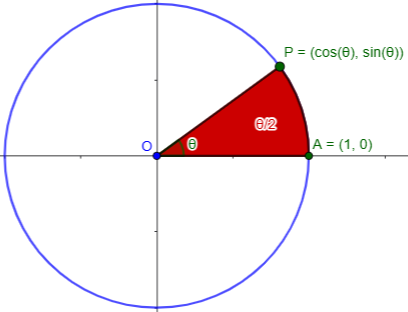
Here we are defining the cosine and sine of a number θ (not treated as an angle, nor even as an arc length), as the x– and y-coordinates of the point for which the area of the sector is half of that number – just because that gives us the functions we are familiar with! Why? Because using angles or arc lengths, which work for circles, would not work well with a hyperbola. As with many definitions, we’ll be using a definition that has been found to be useful, rather that what seems obvious from the start.
Inventing hyperbolic functions
Suppose we work things out in a similar fashion, but on a different conic section; this time on a "unit" hyperbola instead of the unit circle. More precisely, we start off with the curve H, given by:

        x^2 - y^2 = 1

Fix a point A, as before, on the x-axis. A = (1,0). Note that A lies on the curve H.

Take any point P on the hyperbola, again in the first quadrant.

We shall use the area swept out by the "radius" from A to P, i.e. the area bounded by the line OP, the hyperbola arc PA, and the line OA, to parameterize the coordinates of the variable point P.

Let the area swept out be theta/2.  We want to find the coordinates of P in terms of theta. Corresponding to the coordinate functions of a point on a unit circle (which are called the circular functions), the newfound functions will be termed the hyperbolic functions).
Here is what we have:
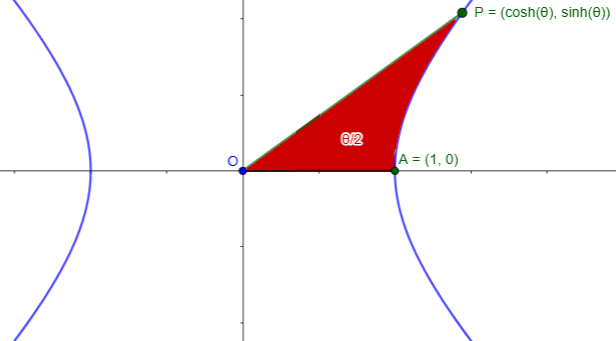
Note that, since θ is not an angle, we normally just call it x; the symbol θ (theta) is being used here only to emphasize the parallel. (It also avoids confusion with other uses of x!)
The remaining development is a series of simple exercises for you.

1. The area swept out is theta/2. Our objective is to find the coordinates of P in terms of theta. So, for the first step, write the coordinates of P as (c(theta), s(theta)) in anticipation that the functions "resemble" those of sine and cosine in the circular case.
I anticipated even more in the picture, labeling the point as \(P(\cosh(\theta),\sinh(\theta))\). But let’s just call it \((c,s)\) for now.
2. Rotate the whole picture (coordinate system) counterclockwise by 45 degrees. Note that the asymptotes of the hyperbola H now become upright and it becomes convenient to set these asymptotes as the principal axes, called Y and X. In terms of Y and X, compute the equation of

a. the old coordinate axes, i.e. the previous x and y axes under this rotation;

b. the hyperbola, under this rotation.
The rotation will make it look like this:
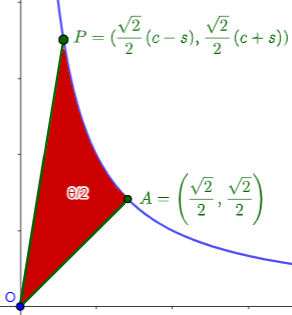
The rotation is given by $$X=\frac{\sqrt{2}}{2}(x-y)\\Y=\frac{\sqrt{2}}{2}(x+y)$$ As a check, note that \((1,0)\) rotates to \(\left(\frac{\sqrt{2}}{2},\frac{\sqrt{2}}{2}\right)\), and \((0,1)\) rotates to \(\left(-\frac{\sqrt{2}}{2},\frac{\sqrt{2}}{2}\right)\). Solving for \((x,y)\), we get $$x=\frac{\sqrt{2}}{2}(X+Y)\\y=\frac{\sqrt{2}}{2}(Y-X)$$
So, in particular, the coordinates of P in the new coordinates are $$X_\theta=\frac{\sqrt{2}}{2}(c-s)\\Y_\theta=\frac{\sqrt{2}}{2}(c+s)$$
The original axes \(y=0\) and \(x=0\) become, respectively, \(Y=X\) and \(Y=-X\), and the equation of the curve \(x^2-y^2=1\) becomes $$\left(\frac{\sqrt{2}}{2}(X+Y)\right)^2-\left(\frac{\sqrt{2}}{2}(Y-X)\right)^2=1\\\frac{1}{2}(X^2+2XY+Y^2)-\frac{1}{2}(Y^2-2XY+X^2)=1\\2XY=1$$
which leads to \(Y=\frac{1}{2X}\), as we can see in the graph.
3. Now, using integration, find the area of the bounded region.
We can find that area by first finding the area of CPAD below, and adding the area of OCP, then subtracting the area of ODA:
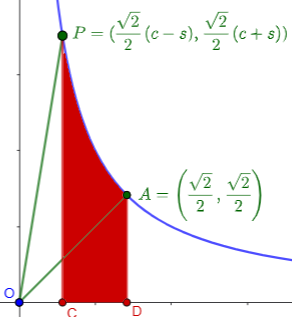
This gives us $$\int_{X_\theta}^{\sqrt{2}/2}\frac{1}{2X}dX+\frac{1}{2}X_\theta Y_\theta-\frac{1}{2}\left(\frac{\sqrt{2}}{2}\right)^2\\=\left[\frac{1}{2}\ln(X)\right]_{X_\theta}^{\sqrt{2}/2}+\frac{1}{2}\cdot\frac{1}{2}-\frac{1}{2}\cdot\frac{1}{2}\\=\left[\frac{1}{2}\ln(\frac{\sqrt{2}}{2})-\frac{1}{2}\ln(X_\theta))\right]\\=\frac{1}{2}\ln\left(\frac{\sqrt{2}}{2X_\theta}\right)$$
Replacing \(X_\theta\) with its value in terms of c and s, the area is $$\frac{1}{2}\ln\left(\frac{\sqrt{2}}{2\frac{\sqrt{2}}{2}(c-s)}\right)=\frac{1}{2}\ln\left(\frac{1}{c-s}\right)$$
4. Knowing that the area should remain invariant under rotation, equate the expression that you have found in (3) and deduce a relation between the two functions c(theta) and s(theta).
$$\frac{1}{2}\ln\left(\frac{1}{c-s}\right)=\frac{\theta}{2}$$
Therefore, $$c-s=e^{-\theta}$$
5. Since (c(theta),s(theta)) lies on H, write down another relation linking these two functions of theta.
We know that $$c^2-s^2=1$$
Dividing this by the value above, $$c+s=\frac{(c+s)(c-s)}{c-s}=\frac{c^2-s^2}{c-s}=\frac{1}{e^{-\theta}}=e^{\theta}$$
6. Solve this system of simultaneous equations.

You should be able to deduce the definitions of hyperbolic sines and cosines.
Adding the two equations and dividing by 2, $$\cosh(\theta)=c=\frac{e^{\theta}+e^{-\theta}}{2}$$
Similarly, subtracting, $$\sinh(\theta)=s=\frac{e^{\theta}-e^{-\theta}}{2}$$
You should now have some idea about the geometrical interpretation of the inverse hyperbolic functions sinh^(-1) and cosh^(-1): they are actually the bounded area as described.
We can also solve for θ to obtain formulas for these inverses; we’ll be doing that later.
Now what have we got?
It will be helpful to visualize the graphs of these functions. First, here are the graphs of the hyperbolic sine and cosine:
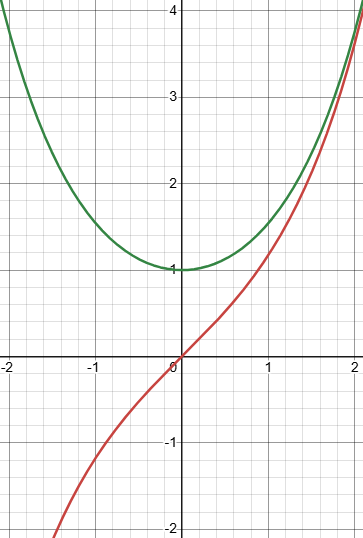
Note that sinh is an odd function (like sine) and cosh is an even function (like cos).
Now, here are the inverse hyperbolic sine and cosine:
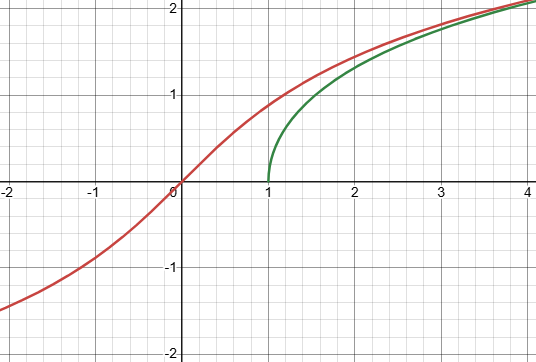
Note that sinh is one-to-one, so its inverse will be straightforward; cosh is not one-to-one, so we will have to choose one inverse (most naturally, the positive value).
Clearly these look nothing like the sine and cosine; they are hyperbolic analogues of those only in their meaning and their identities, not in their form!
Here are a couple of the identities we can derive from the formulas, showing that parallel:
First, from the equation of the hyperbola, we know that $$\cosh^2(x)-\sinh^2(x)=1$$
Then, we can define more functions, such as tanh on analogy with tan: $$\tanh(x)=\frac{\sinh(x)}{\cosh(x)}$$
And we can even obtain formulas like this: Knowing that $$\sinh(x+y)=\frac{e^{x+y}-e^{-(x+y)}}{2}=\frac{e^{x}e^{y}-e^{-x}e^{-y}}{2},$$ we can guess, by comparison with trig, that this is equal to \(\sinh(x)\cosh(y)+\cosh(x)\sinh(y)\), and check that: $$\sinh(x)\cosh(y)+\cosh(x)\sinh(y)=\\\frac{e^{x}-e^{-x}}{2}\cdot\frac{e^{y}+e^{-y}}{2}+\frac{e^{x}+e^{-x}}{2}\cdot\frac{e^{y}-e^{-y}}{2}\\=\frac{e^xe^y+e^{x}e^{-y}-e^{-x}e^{-y}-e^{-x}e^{-y}}{4}+\frac{e^xe^y-e^{x}e^{-y}+e^{-x}e^{y}-e^{-x}e^{-y}}{4}\\=\frac{2e^xe^y-2e^{-x}e^{-y}}{4}=\frac{e^xe^y-e^{-x}e^{-y}}{2}=\sinh(x+y)$$
There are many other such parallel identities.
Inverse hyperbolic sine
Now let’s look at the inverse functions, by way of a 2003 question:
Defining the Arcsinh Function

I just got an assignment on hyperbolic functions, which I've never seen before. The first part was proving several identities, similar to the trig identities, so I'm semi-familiar with cosh and sinh now.

The second part is to solve an exact value for x in: 4 sinh x = 3

I can work out that

   e^x - e^-x = 3/2 and
 e^2x + e^-2x = 15/4

but with every identity I try to substitute, etc., I always end up with one of these two equations.
Simon obtained the first equation using the definition of sinh. From \(\sinh(x)=\frac{e^{x}-e^{-x}}{2}\), we see that if $$4\sinh(x)=3,$$ then $$\frac{e^{x}-e^{-x}}{2}=\frac{3}{4},$$ and therefore $$e^{x}-e^{-x}=\frac{3}{2}.$$
The second equation may come from squaring that one: $$\left(e^{x}-e^{-x}\right)^2=\left(\frac{3}{2}\right)^2\\e^{2x}-2+e^{-2x}=\frac{9}{4}\\e^{2x}+e^{-2x}=\frac{9}{4}+2=\frac{17}{4}$$
He seems to have a small arithmetic error. The important thing is that we still have two separate exponential expressions no matter what we do.
Doctor Warren answered:
Hi Simon,

The easiest way to deal with this equation is to use the definition of the arcsinh function:

   arcsinh(z) = ln(z + sqrt(z^2 + 1))

Your equation's solution is, of course, x = arcsinh(3/4).

If you don't have the definition of the arcsinh function handy, you can derive it with only a couple of identities:

   Identity 1) sinh(z) + cosh(z) = e^z
   Identity 2) cosh^2(z) - sinh^2(z) = 1
The answer could already be considered exact, since scientific calculators can solve this directly (on my TI 30X-IIS, I type in “[2nd][HYP][2nd][SIN\(^{-1}\)]3 ÷ 4)=” and get 0.693); but quite likely more is expected, and “exact” is taken to mean “using one of the functions you already know”, rather than “using a calculator button we forgot to teach you about”.
By the way, as I mentioned in Inverse Trig Notation: What Do sin^-1 and arcsin Mean?, the modern notation for \(\sinh^{-1}\) is arsinh rather than arcsinh, precisely because, as we learned above, the argument of sinh is not an angle (arc), but an area (ar)! But we didn’t know that in 2003.
The second of the two identities was pointed out above; the first can be easily demonstrated using the definitions: $$\sinh(x)+\cosh(x)=\frac{e^{x}-e^{-x}}{2}+\frac{e^{x}+e^{-x}}{2}=e^x.$$ Similarly, $$\cosh(x)-\sinh(x)=\frac{e^{x}+e^{-x}}{2}-\frac{e^{x}-e^{-x}}{2}=e^{-x}.$$
So how do we find an equation for the inverse function?
Start with

   x = sinh(y).                          (1)

Substitute x into Identity 1:

   x + cosh(y) = e^y                     (2)

Rearrange Identity 2 in terms of cosh(y):

   cosh(y) = sqrt(1 + sinh^2(y))       (3)

Substitute (3) into (2):

   x + sqrt(1 + sinh^2(y)) = e^y       (4)

Substitute (1) into (4):

   x + sqrt(x^2 + 1) = e^y               (5)

Take the natural logarithm of both sides:

           y = ln(x + sqrt(x^2 + 1))
  arcsinh(x) = ln(x + sqrt(x^2 + 1))     (done)

You can take it from here.  Let me know if you have any more questions.
(By the way, we can take the square root of \(\cosh^2(x)\) without ± at equation (3) because cosh is always positive.)
We’ll see another derivation below.
Let’s now solve the problem:
We want to evaluate \(\sinh^{-1}\left(\frac{3}{4}\right)\). Plugging into the formula, $$\sinh^{-1}(x)=\ln\left(x+\sqrt{x^2+1}\right)\\\sinh^{-1}\left(\frac{3}{4}\right)=\ln\left(\frac{3}{4}+\sqrt{\left(\frac{3}{4}\right)^2+1}\right)=\ln\left(\frac{3}{4}+\sqrt{\frac{25}{16}}\right)=\ln(2)$$
It’s that simple, and “exact” in the sense Simon would be familiar with. As a decimal, \(\ln(2)=0.693\), as I got directly above.
Simon replied,
Thanks heaps, you've made my life a whole lot easier!
We can also solve this without having a formula. First, we write our equation, \(4\sinh(x)=3\), using the definition, \(\displaystyle\sinh(x)=\frac{e^{x}-e^{-x}}{2}\): $$4\frac{e^{x}-e^{-x}}{2}=3\\2e^{x}-2e^{-x}=3$$
Now substitute \(u=e^x\), obtaining $$2u-2u^{-1}=3$$
Multiplying by u, $$2u^2-2=3u\\2u^2-3u-2=0\\(2u+1)(u-2)=0$$
So \(u=2\) or \(u=-\frac{1}{2}\).
Back-substituting, \(e^{x}=2\) or \(e^{x}=-\frac{1}{2}\).
Solving, \(x=\ln(2)\); the second solution does not exist (actually, it would be complex).
In effect, we’ve derived the formula. But it leaves an interesting question: What happened to that extraneous solution when we used the formula? I’ll leave that for you to ponder.
Using the inverse hyperbolic cosine … or not
An anonymous question from three months earlier in 2003 initially has nothing to do with hyperbolic functions, but will get there by a “scenic route” that will take us to some interesting places:
Inverse Hyperbolic Cosine in Terms of ln

What is t in the equation ln(e^0.1t + 9e^-0.1t) = ln 10?

There are no rules governing an "expansion" of the ln, or even how to do ln 9e^-0.1t

I know from just substituting some numbers that ln(e^0.1t + 9e^-0.1t) does not = ln e^0.1t + ln e^-0.1t.
The student wanted to distribute the log, but knew that was wrong; there is no rule to simplify \(\log(a+b)\). In this discussion, we’ll see two Math Doctors missing important ideas, in ways that accidentally let us discuss some very useful concepts. In the process, we’ll “invent” hyperbolic functions as a way to solve the problem, and then discover that we didn’t really need to!
It looks impossible
Doctor Mitteldorf started pessimistically:
Hi there,

I understand your frustration, but I suggest that it derives from a simple truth that none of your instructors has yet revealed to you: The vast majority of equations that you might write down do not admit of an algebraic solution.

This fact is occluded in the educational process by the (understandable) tendency of teachers to focus on those problems that DO have algebraic solutions. This leaves most students with the impression that ALL algebraic equations have algebraic solutions, and consequently that a failure to discover a solution for a given equation reflects poorly on their own ability as mathematicians.
I often point this out to students: We teach what we can do, and often fail to mention how big a restriction this is! For a similar observation, see Integration: Sometimes It Just Can’t Be Done!
In fact, the equation that you have written

   ln(e^0.1t + 9e^-0.1t) = ln10

cannot be solved for t.  You can raise e to the power of each side

   e^0.1t + 9e^-0.1t = 10

But this is as far as you can go. One way is to guess values of t, evaluate the LHS, and see how close you get to 10, then use the disparity to help with your next guess. This is called "Newton's Method" or the Newton-Raphson method.

   Inventing an Operation to Solve x^x = y
   http://mathforum.org/library/drmath/view/54586.html
This might well be my first impression, too (in fact, as we’ll see, it was!); and it’s important to be aware of numerical solution methods, which are often needed. But not, it turns out, here!
But the equation reminded Doctor Mitteldorf of a similar problem that can be solved:
If you didn't have the 9, however, there would be a combination of symbols that is conventionally notated as the "hyperbolic cosine" or cosh, defined as

   cosh(x) = (e^x + e^-x)/2

If you take your equation (without the 9) and raise e to the power of each side, you have

   cosh(0.1t) = 20

This gives a solution of the equation as an inverse hyperbolic cosine.  In one sense, this is an answer; but in another sense it just assigns a name to an iterative calculation that arises because there is no algebraic solution.
So the solution to that equation would be \(t=10\cosh^{-1}(20)\). And that, in turn could be expressed in terms of logs, using the formula we saw above, but in this context, he evidently forgot about that (which didn’t seem directly relevant anyway). I’ll comment on the “assigns a name” idea below.
But we can use cosh to solve our problem!
I saw something more, and joined in the conversation:
Hi.

I'd like to add a bit to Dr. Mitteldorf's excellent answer.

He transformed your equation to the form

  e^0.1t + 9e^-0.1t = 10

and mentioned that a special function has been defined,

  cosh(x) = (e^x + e^-x)/2

I notice that your equation (with the 9) can be rewritten using the hyperbolic cosine:

  1/3 e^0.1t + 3 e^-0.1t = 10/3              [dividing by 3)

  e^(0.1t-ln(3)) + e^(-0.1t+ln(3)) = 10/3    [moving coefficients]

  [e^(0.1t-ln(3)) + e^(-0.1t+ln(3))]/2 = 5/3 [dividing by 2]

  cosh(0.1t-ln(3)) = 5/3                     [using the function]

  0.1t - ln(3) = cosh^-1(5/3)                [taking the inverse]

  t = 10[ln(3) + cosh^-1(5/3)]               [solving]
So Doctor Mitteldorf actually provided the tool we needed for a solution, thinking it was just an aside!
The power of definition
This suggested a broader idea, namely that defining a new function can be a way to solve the unsolvable, but changing what it means to solve!
As he pointed out, cosh is just a new name given to something that otherwise would have to be solved by numerical methods, so in a sense this is not really an algebraic solution; but the fact that we can use algebra to manipulate a new equation into the form of one that has been given a name means that we have actually accomplished something.
Perhaps the first example of this that you saw was when your teacher gave a name to the number whose square is a given number, calling it the square root and giving it a special symbol: \(x=\sqrt{y}\) names the solution to \(x^2=y\), without telling you how to calculate it!
This is not uncommon in more advanced applications of algebra or calculus: we find a whole class of equations that can be solved using a single new function (or group of related functions, such as the hyperbolic functions), so that by making tables (in the old days) or writing a program to evaluate the newly introduced functions, we can solve many problems. So a lot of the algebra you do in solving problems like this is to transform your problem into the "standard" form for its class (once you have recognized what that is). Other examples of such special functions used in solving classes of problems include the Bessel functions, the Elliptic integrals, and so on. The logarithms and the trigonometric functions are more familiar examples.
We saw a similar idea when we looked at impossible integrals, some of which are given names, making new classes of integrals “solvable”. Even the square root function can be thought of as giving a name to what you want to find.
I'm not sure I would have noticed that cosh could be used to solve this problem without Dr. Mitteldorf pointing it out. (I hope I would, but...) There can be a lot of "art" involved in this sort of thing; it's like being lost at sea and having to recognize by the smell of the air which group of tropical islands is nearest, and finding a way to head in that direction, rather than just following a compass home. When you finally land on Hyperbolia the natives can care for you. It would be nice if there were a simple procedure that would always get you "home" without having to use what amounts to intuition to see what direction to go in; but despite whatever we say to kids to encourage them, it remains true that "math is hard"! It's only the basic problems (which tend to be taught in school) that are "easy."

Fortunately, in modern life there are plenty of tools to solve equations for you numerically, so if you understand the basics, these hard parts can be done automatically. We don't all have to be South Seas navigators.
But also, we can derive an equation for the inverse cosh!
A few hours later I realized we can go further:
Hi.

Thinking again about this problem, I realized that the inverse hyperbolic cosine CAN be expressed algebraically in terms of ln, so although our general advice about non-algebraic solutions is valid, it is not necessary here. We CAN solve your problem without resorting to a calculator that knows cosh^-1.
So now I derived that inverse equation, since we’d already given the equations for the functions themselves.
Here is how to derive an equation for cosh^-1:

Suppose we know that

  cosh(u) = v

That is,

  e^u + e^-u = 2v

Then we can multiply through by e^u:

  e^(2u) + 1 = 2v e^u

This can be written as a quadratic equation in e^u:

  (e^u)^2 - 2v (e^u) + 1 = 0

Now we can solve for e^u using the quadratic formula:

  e^u = [2v +/- sqrt(4v^2 - 4)]/2

      = v +/- sqrt(v^2 - 1)

  u = ln(v +/- sqrt(v^2 - 1))
But which sign do we use? There’s a funny thing about that …
It turns out that $$\ln\left(v+\sqrt{v^2-1}\right)=-\ln\left(v-\sqrt{v^2-1}\right),$$ because $$\ln\left(v+\sqrt{v^2-1}\right)+\ln\left(v-\sqrt{v^2-1}\right)\\=\ln\left(\left(v+\sqrt{v^2-1}\right)\left(v-\sqrt{v^2-1}\right)\right)\\=\ln\left(v^2-\left(v^2-1\right)\right)=0$$
So there are in fact two values for \(\cosh^{-1}(x)\), because cosh is not one-to-one; we are just choosing whether to take the positive or negative value as the principal value. We want the positive, so we find that $$\cosh^{-1}(x)=\ln\left(x+\sqrt{x^2-1}\right)$$ We saw above that $$\sinh^{-1}(x)=\ln\left(x+\sqrt{x^2+1}\right)$$
Now we can solve the original problem, with or without inverse cosh
You can either apply this expression for the inverse hyperbolic cosine to what I wrote, or else apply the same technique to solve your problem directly, by multiplying your equation (in exponential form) by e^(0.1t) and writing it as a quadratic.
Let’s do both.
First, applying this expression for \(\cosh^{-1}\) to our solution above: $$t=10\left[\ln(3)+\cosh^{-1}\left(\frac{5}{3}\right)\right]\\=10\left[\ln(3)+\ln\left(\frac{5}{3}+\sqrt{\left(\frac{5}{3}\right)^2-1}\right)\right]\\=10\left[\ln(3)+\ln\left(\frac{5}{3}+\sqrt{\frac{16}{9}}\right)\right]\\=10\left[\ln(3)+\ln\left(3\right)\right]=20\ln(3)$$
Next, solving from scratch by the same technique:
We’re solving $$e^{0.1t}+9e^{-0.1t}=10$$
Now we make the substitution \(u=e^{0.1t}\), and the equation becomes $$u+9u^{-1}=10$$
Multiplying both sides by u, we get $$u^2+9=10u\\u^2-10u+9=0\\(u-9)(u-1)=0$$
So \(u=9\) or \(u=1\). Reversing the substitution, \(e^{0.1t}=9\) or \(e^{0.1t}=1\), which leads to the solutions \(t=10\ln(9)=20\ln(3)\) and \(t=0\). (The latter is a valid solution; we missed it before because we forgot that there are two inverses, differing by the sign. When we take the negative value, we find that $$t=10\left[\ln(3){\color{Red}{-}}\cosh^{-1}\left(\frac{5}{3}\right)\right]=10\left[\ln(3){\color{Red}{-}}\ln(3)\right]=0$$
That was easy!
But we took the scenic route, discovering some new islands (“Hyperbolia”) along the way, which we never would have seen if we’d seen the quick way.
I'm sorry it took so long for us to recognize this solution!

Note that, as we said, solutions to problems like this tend to depend on knowing the right tricks; you can see that it is easy even for us to miss a solution if we get our minds on the wrong track.
The student responded:
To Drs. Mitteldorf and Peterson,

You have brightened my day. This site has to be the best thing for people like me who are not "south sea navigators" (as Dr. Peterson said) but who have to do a bit of mathematics in their respective applications (I do medicine - and I've done some physics and more basic maths in the past, but I've never done the "higher level stuff," only dabbled in from time to time. I'm learning it now as I go.

I hope everyone thanks you for all your hard work and polite answers!
Cheers,
A student of the University of Queensland, Brisbane, Australia
Next time, I’d like to look at some amazing relationships between trig and hyperbolic functions related to complex numbers.
Pingback: Hyperbolic and Circular Functions and Complex Numbers – The Math Doctors